How To Find Your Property On FEMA’s Flood Insurance Rate Maps

What are FEMA flood maps?

FEMA’s Flood Insurance Rate Maps (FIRMs) or just Flood Maps are provided after a flood risk assessment has been completed or updated for a community.  This study is known as a Flood Insurance Study.  The FIRM gives you the Base Flood Elevations (BFEs) and insurance risk zones in addition to floodplain boundaries.  The FIRM may also show a delineation of the regulatory floodway.

Once the “insurance risk zone”  (commonly referred to as the flood zone) is determined, actuarial rates, based on these risk zones, are then applied for newly constructed, substantially approved, and substantially damaged buildings.  FEMA uses these rates to determine the insurance rate you will pay for flood insurance

FEMA’s Digital Flood Maps

FEMA discontinued the production and distribution of paper flood maps in 2009 as part of its Digital Vision Initiative. This affected all the Flood Maps, boundary information, and study reports. However, clients can still view the products for free through their website or buy them in digital format.

To view these flood maps online, go to FEMA’s Map Service Center and key in your address (hi-lited area shown here) search for your home.  This will prompt you to then select the map that covers your area.  The Flood Maps are somewhat cumbersome to use online. It is best to go through the tutorial on the bottom right of the address search page for an easier and more effective use of the GIS map.
More Posts

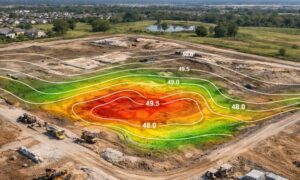
Aerial drone view of a construction site showing subtle elevation changes and contour overlay illustrating lidar mapping across a flat lot
land surveying
Surveyor

How Lidar Mapping Helps You Spot Hidden Low Spots Early

Houston land can trick you. A lot may look flat and ready. The surface feels smooth. Nothing stands out, so it seems safe to build. Then the rain comes. Water starts to sit in one corner. The yard stays wet longer than it should. A driveway slopes the wrong way.

Read More »
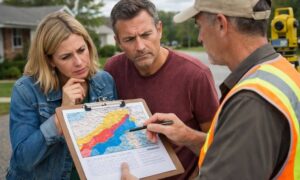
A surveyor measuring a residential property with a semi-transparent flood map overlay showing property boundaries and elevation
land surveying
Surveyor

Confused by Flood Maps? How a Land Survey Company Helps

If you’ve been hearing about the new flood maps, you’re not alone — they’re causing a lot of confusion. Areas that weren’t considered at risk before are now marked as flood zones, leaving homeowners wondering what it means for their insurance, renovations, or even the value of their property. A

Read More »

Finding Land Surveyors Starts With the Right Questions

Searching for land surveyors in my area usually starts when a property decision feels urgent. Maybe you are buying land, planning an addition, checking a boundary, or getting ready for permits. In Houston, TX, that choice matters because accurate survey information can affect planning, approvals, and how smoothly a project

Read More »
Aerial view of a residential property with clearly marked boundary lines from a land survey showing the full layout of the lot
land surveying
Surveyor

Land Survey Guide for No-Zoning Areas

If you hear that Houston has no zoning, it sounds simple. At first, you might think you can build anything you want. However, that idea causes a lot of problems for property owners. Houston is different, but it is not without rules. Instead of one zoning map, the city uses

Read More »
Example lot survey showing easements, building lines, and access areas on a residential property
land surveying
Surveyor

Understanding a Lot Survey: Easements, Setbacks & Access

You plan to build a fence. Or maybe you want to add a small patio or extend your driveway. Everything seems simple at first. However, many property owners run into a problem they did not expect. Someone points at a drawing and says, “You can’t build there.” That drawing is

Read More »
A licensed surveyor using equipment to verify property lines in the field
land surveyor
Surveyor

How a Licensed Surveyor Can Help Verify Your Property Lines

You walk through your yard and feel confident about your property line. The fence looks straight, and the edges seem clear. Then you check your plat or deed—and suddenly, nothing matches. You start wondering: Is the fence really in the right spot? Does the plat reflect reality? Can you trust

Read More »